
Category: Uncategorized
Blog posts
Posts
Bibliography
Sara Ahmed, The Cultural Politics of Emotion (Edinburgh University press and Routledge, Edinburgh, 2004)
Bazil Bunting, Complete Poems (Northumberland, Bloodaxe, 2000)
Gotfried Wilhelm Hegel, Hegel on Art, Religion, Philosophy (London, Harper Torchbooks, 1970)
Georg Wilhelm Freidrich Hegel, Hegel’s aesthetics, Lectures on Fine Art, Volume 1 (Oxford, Clarendon Press, 1975)
Peter Makin, Bunting: The Shaping of his verse (Oxford, Clarendon Press, 1992)
Mari J Matsuda, When the first Quail calls: Multiple Consciousness as Jurisprudential Method (14 women’s Rights law Reporter, 1992)
Arthur Schopenhauer, The World as Will and Representation, Volume 2 (New York, Dover, 2016)
Eyal Weizman, Open Verification, https://www.e-flux.com/architecture/becoming-digital/248062/open-verification/ accessed 12/11/2019
William Carlos Williams, Collected Poems 1, 1909-1939 (Manchester, Carcanet, 2000)
William Carlos William, Patterson (Cambridge, New Directions, 1995)
Ideas on Neoliberalism:
Harvey’s ideas in David Harvey, ‘NeoLiberalism as creative desctruction’, The Annals of the American Academy of Political and Social Science, Vol. 610, March 2007, pp.22-44.
Robin James, The Sonic Episteme, Summary argument, book now published:
Robin James, The Sonic Episteme: Acoustic Resonance, Neoliberalism and Biopolitics (Durham, Duke University Press, 2019)
Ideas of Essence and general phenomenology:
Martin Heidegger, The Question Concerning Technology and Other essays, (London, Harper Torch Books, 1977)
Edmund Husserl, The Paris Lectures, (Amsterdam, Kluwer Academic Publishers, 2013)
The Sound-recording into composition- Blog Post nine
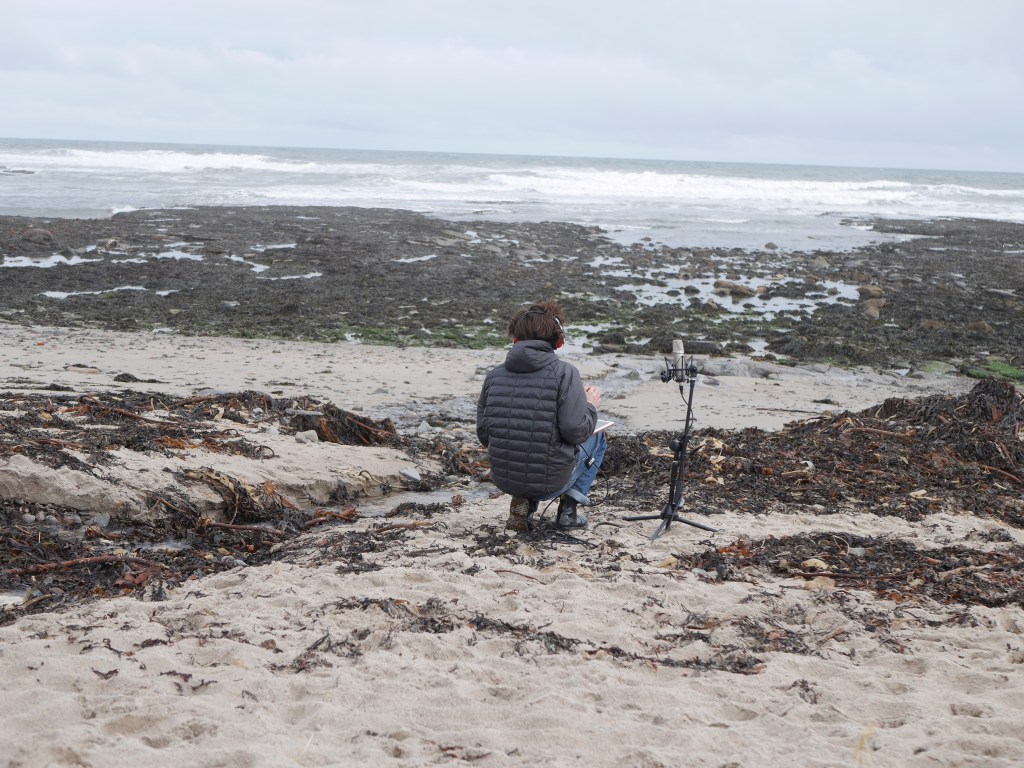
Discussing the song recordings, as the basis of musical motifs in the piece is necessary. To create music that was based directly on the material world was a key starting point. The sensations of the material world, along with the voices of the local, are brought to the listener, entangling the listener and the composition. All the musical material is based on four separate field recordings that I made in the North East; half rural and half urban. Two recordings are in Newcastle city center, the first around a university campus, and the second is between the quayside and the center. These points of the city provided a juxtaposition; new buildings in a pedestrianized area that optimized a Neo-liberal space, with dull architecture, small supermarkets and cafes, and then older buildings, independent bars and take away shops, that hardly survive, and often are constantly changing. The third recording was made in a very small seaside village called Seahouses, where building work was being done on the harbor, and growing tourism had completely changed the area. The last recording was made on a beach near Beadnell (Berwick upon Tweed). These places were chosen carefully, all massively effected by cultural, ecological and political problems but all places that could be relatable for listeners.
To compose from the sounds in these spaces I had to listen to them, and find motifs, and freeze them in time, allowing them to become moments in my composition. Different motifs were taken and then layered, and at times, they hopefully create the sonic illusion of a city, village, or beach. These motifs do not sound like their source material always, as they are harmonized, rhythmically augmented and slowed down, and then sewn into a new soundscape, but as a new wholeness, with voices of the local, from past and present, and descriptions of the landscape. This should further immerse the listener into the North-East local that I have based the piece on, but also beyond that. The local here gives way the trans-local, with an aesthetic wholeness.
The Sound-recordings are featured Bellow:
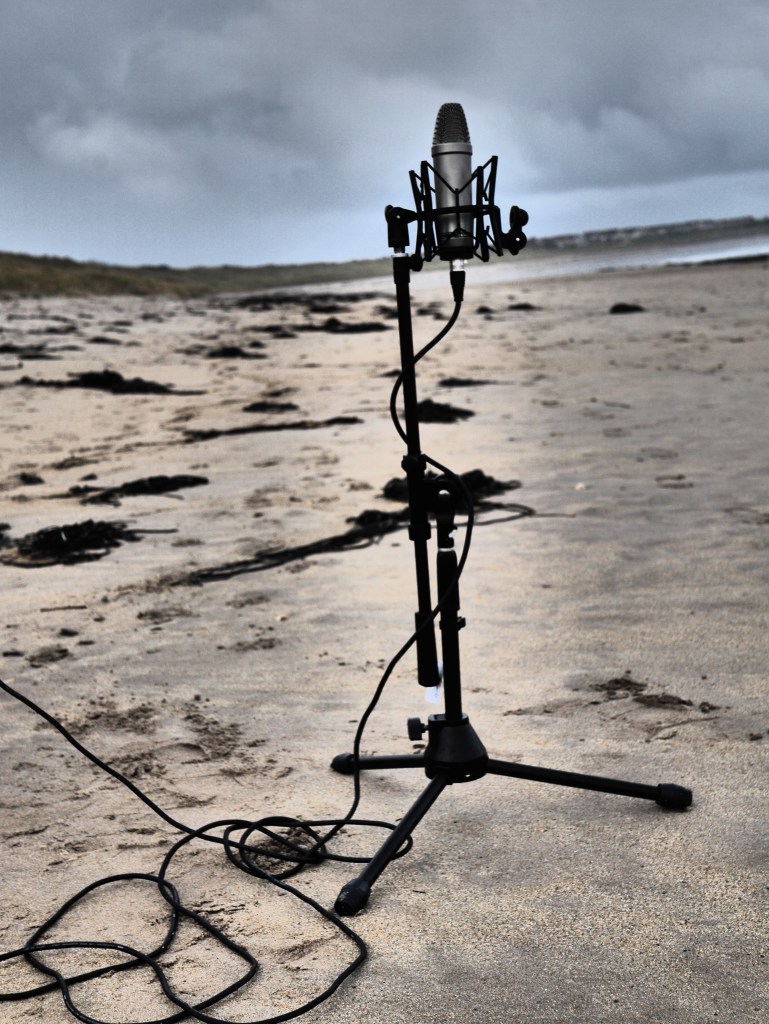
Quayside
https://soundcloud.com/user63435013/quayside
https://soundcloud.com/user63435013/quayside-1
University
https://soundcloud.com/user63435013/university
Seahouses
https://soundcloud.com/user63435013/seahouses
https://soundcloud.com/user63435013/seahouses-1
Beach
https://soundcloud.com/user63435013/beach-and-sea-2
https://soundcloud.com/user63435013/beach-and-sea-3
Composing from these sources
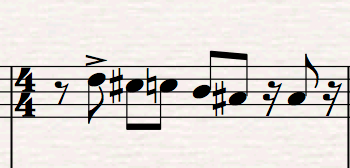
The very short sections of the score show a clear example of the compositional process. These motifs are simply based on the ‘Quayside’ sound recording, and hopefully, in an immediate sense, capture the essence of a car. What I mean by this is the music creates the sonic information that one would still think that this may sound like a car, the timpani acting like the wheels on a street, and the cello like a motor. This creates the ‘thing’ car, hopefully in the simplest way possible. It is just two instruments that have been used to create a sensation that may be associated with the signifier ‘car’. A certain kind of musical economy is being used to hear, to capture the thing, which could be compared to an economy of language, popular with modernist poets, like William Carlos Williams and, more applicably, Basil Bunting,who also relates more closely to the Northumbrian aesthetic, giving this method a higher significance in the composition of the piece.
Score (Timpani on the left, Cello on the right)
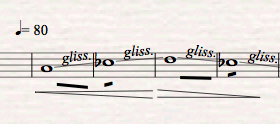
Timpani part in ‘Quayside’ 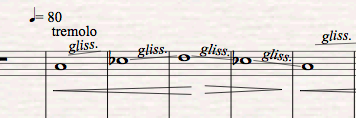
Cello part in ‘Quayside’
Scholars have pointed to Northumbrian poet Basil Bunting’s work, and related it to the most famous work of art conceived in the North East of England; the Lindisfarne Gospels. Bunting scholar Pete Makin illuminates connections between the gospel and modernist poetry: ‘the painter has reduced the many roundnesses of the animal’s head to three flat planes’, which is thus named ‘simplification: to find the essential line that suggests.’ (Pete Makin, Bunting: The Shaping of his Verse, (Oxford, Clarendon Press, 1992) p.222-223) The music here hopefully finds the essential line, and uses this line for ‘pattern making’, in a ‘geometrized’ way, which clearly relates to the Northumbria aesthetic. (p.223-224) I find the minimum amount of lines in my composition to conceive the object and then I weave this into a larger pattern through repetition and slight change of motif, which moves towards a centre, and then the pattern comes back out again.
Echternach and Gospel of St. Mark from Lindisfarne Gospel dated around 700 ( images from Pete Makin, Bunting: The Shaping of his Verse, (Oxford, Clarendon Press, 1992)
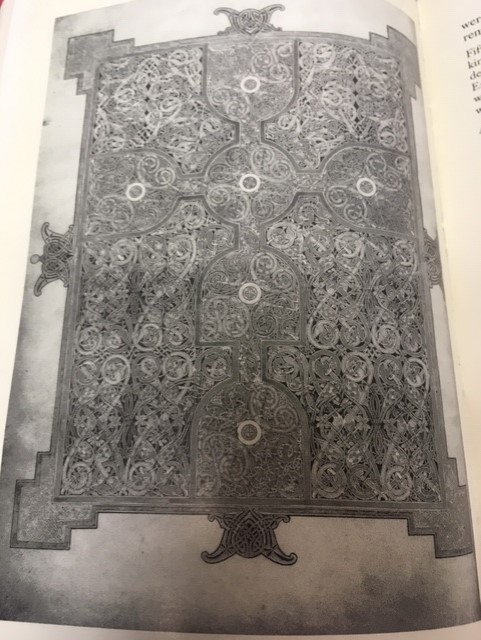
Lindisfarne Gospel, cross-carpet page introducing the Gospel of St Mathew, British Library 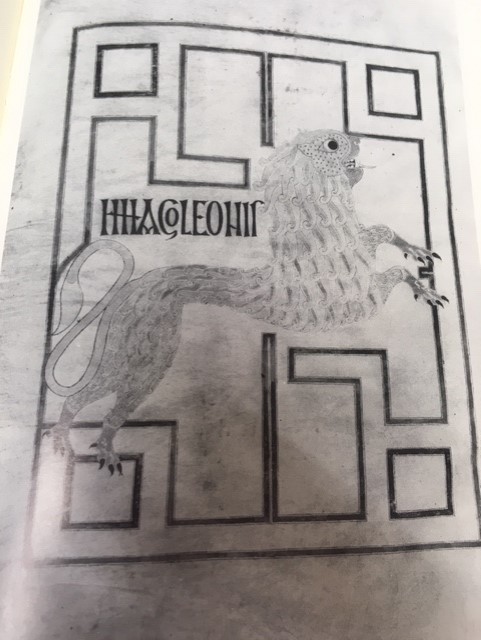
Echternach Gospels, symbol of St Mark, Bibliotheque National
Here, like Bunting’s poetics, I attempt to capture the essence of place, which includes parts of its history. Considering the North East of England and not to consider an aesthetic history here would have been a missed opportunity to capture the local. This compositional technique ties the lyrical and the music, the semblance and the soul so to speak, to locality. The historical is embedded in aesthetic decisions here, which creates a grander emphasis on particular local histories, which again, speaks to translocal experience. The local does not refer to an aggressive patriotism, but an immediate surface where one can see the effects of systemic problems.
Work in progress motifs from the score


The composition- Blog post eight
This project is a compositional shift from the work I normally do. Normally I write short songs, written on a guitar and not planned meticulously before being recorded. For this project a carefully considered aesthetic strategy felt necessary, as although the songs I write are immediate, I felt like something grander with clearly carved out ideas would push my compositional work further, and allow me to consider larger aesthetic questions, as well as social, political, cultural and ecological ones.
The shift away from songwriting, in a more traditional sense, was difficult. The advantages of song writing are clear; quick satisfaction is available, as one can quickly compile and compose a song that sounds good in the 21st century, while remaining accessible to many. It is also far easier to record when structure is flexible, or if you are playing with other people the music is often composed collectively. Ideas are quick in the context of a pop song, but I felt like the music was not always as accountable as I wanted it to be. I wanted every note, every word, every decision, to contribute to the ideas driving the piece. This allowed me not only to feel careful when dealing with the local and the more abstract philosophical ideas, but also allowed me to take time and care in the subject matter of the piece, which will hopefully allow the audience to do the same.
Political concerns- Blog post seven
What does this project aim to do? What is the point of taking the sounds of local places and voices and transcribing them into musical unity? Among other things, emphasizing the qualitative experience of place, instead of the statistical, normalization that quantified neoliberalism employs, is acting against the neoliberal market economy. Re-igniting an emphasis on sensation, and the way art shows our intersubjectivity through empathy, is key to reacting against our currently socio-political, ecological and cultural climate. The quantification through statistics has ultimately created a breakdown of systems of communication, an excess of alienation. We can see this in the music industry; charts ranking not on quality of music, but quantified sales, Spotify creating algorithms based on persona; ‘data’ encrypted by numbers, and compression tools used so much that music is squashed to a level where music sounds most similar; the list goes on. This is what my project is reacting against, and hopefully the audience will be able to feel that.
*It would be unfair not to mention the fact that I wrote this particular post after reading the pre-published version of Robin James’ Sonic Episteme, which relates Neo-liberal politics and music.
Re-addressing musical concerns- blog post six
When the sounds of the local are recreated, but with added harmony, they become more than they are in their environment, presented in aesthetic unity. They become musical motifs of sensuous energy that can be seen as synonymous with Schopenhauer’s idea of the Will. Making music from the experiences of people in an area, and the area itself shows these elements combined with harmony; a harmony that resonates through all things, dissembling our individuality as metaphysical energy, like the Will. The idea of the Will is particularly applicable to music because Schopenhauer says ‘music does not, like all other arts, exhibit the idea or grades of the Will’s objectification, but directly the will itself.’ (Schopenhauer, p.448) Schopenhauer also says how music acts directly on the Will by raising or altering feelings and passions, so that makes music an immediate way to feel local places in a way that does not rely on language but feeling itself as a tool of communication. Music allows us to access ‘secret information on the feelings expressed in the worlds’ in their ‘real true nature’ (Schopenhauer, p.448). The raw meta-physical thing in itself can be accessed by music for Schopenhauer. Schopenhauer also says poetry is ‘welcome’ in music, however, and being able to relate to the phenomenal world is key to the particular project I am doing. The music transcends the material world of the lyrical, but the lyrical ideas do give a reference point for the listener that can improve the surface of the music.
Discussing the surface and the metaphysical side of art is key to Hegelian aesthetic ideas where the ‘semblance’ and ‘sensuous’ should correspond directly. Hegel’s theories on art deal with the direct tension between the ‘two contradicting worlds’ one of eternal being, one of the phenomenal now, which both deal with a kind of different truth. The sensuous side deals with eternal being and the semblance deals with the phenomenal now. The metaphor of human body and spirit and how body can represent spirit is a useful way of understanding Hegel’s ideas of aesthetics.
Reconsolidating ideas- Blog Post five
Creating a small series of pieces, that explore metaphysical aesthetics in music, while grounding the lyrical content of the music in the local, is a roundabout way of describing the project that I am doing so far. The North-East of England is the particular location that I am basing the music and lyrics of the pieces on. Speaking to people and experiencing the place is key to constructing this narrative; allowing snippets of witness-like testimonies and atmosphere to be combined with music. This brings these perspectives into a collective transcendental state; a transcendental intersubjectivity, made from people and place. The listener will hopefully be able to connect with the piece, and then connect this experience to experience in the world. Using multiple perspectives in an aesthetic context allows the voices to be heard in a different way, where feeling, or empathy, is considered.* When I say empathy, I do not mean it in the common use of the term, I mean it in the context of one person understanding another, through feeling, showing intersubjectivity. The very fact that music exists is evidence of intersubjectivity, relying on subjective empathy.
*Husserl’s phenomenology considers this.
Creating an idea of collective ‘truth’ is key to projects like forensic architecture. One of the founders of the group Eyal Weizman infers that now we must rely on collective truth, from humans and their surrounding environment, when trying to assemble any form of ‘truth’. Using multiple ‘sensors’ for the basis of the piece (human experience, sound recordings of the environment, written descriptions of the place) allow a picture to be created of the local. Anthropocentric dialogues are also disturbed by giving importance to the sounds of the environment that the people live in. Aesthetics being the ‘science of the senses’ (Hegel, On Art, Religion, Philosophy (London, Harper Torch Books, 1970) p.22), it makes sense to use multiple ‘sensors’ to create the piece. Structures and harmony can be based on repetition and focusing in on the sensations created by place. Aesthetics allows us to understand these sensations created by the environment and the effect that this will have on people’s experience of living in an area. Of course, compositional touches will be added, to cater to ideas of the aesthetic ‘whole’, the surface of the piece matching the so-called ‘soul’. Even reminiscent sensations of the environment of the city, for example, can change the way someone thinks and feels about that given environment. (This is an idea from Hegelian aesthetics).
William Carlos Williams- Blog Post four
The lyrics of the piece will be grounded in the world of representation. As I have said, local experience is extremely important to the piece of music. Who better writes of local experience than American modernist poet William Carlos Williams? In his work Paterson, the town Paterson, New Jersey, becomes a realm of collective experience, weaving together the everyday and history. His other books like Al Que Quiere!, Sour Grapes and Spring and all touches all from women to children, to sparrows and their habits. The poems paint pictures of the local and provide a great inspiration for creating collective experience, and the essence of place. Observation and conversation become pure artistic means, allowing voices and characters to be heard.
Some of Williams poems can demonstrate this:
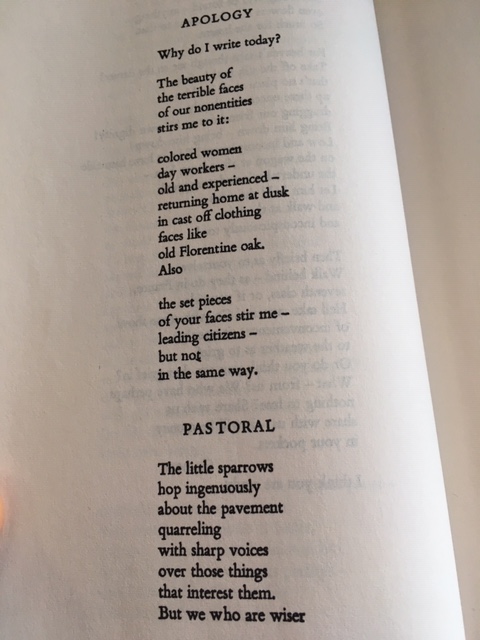
‘Apology’ and ‘Pastoral’ from Al Que Quiere! 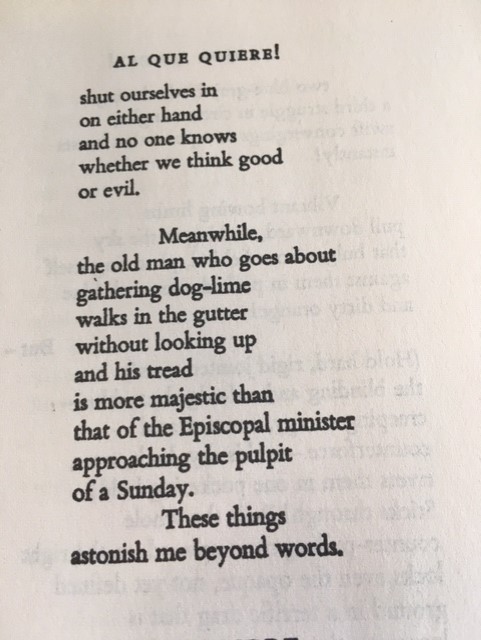
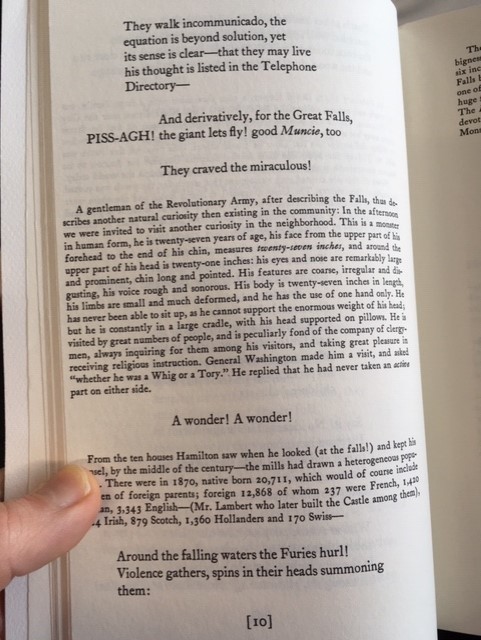
Section from Paterson Book One
William Carlos Williams, Collected Poems 1, 1909-1939 (Manchester, Carcanet, 2000)
William Carlos William, Patterson (Cambridge, New Directions, 1995)
 Composing the North East